Personality, Power, and Purpose: The Pillars of Potential

Updated: 2 days ago
Through my exploration of the human experience, a recurring pattern emerged that led to the development of a structured framework for growth. The three pillars, Personality, Power, and Purpose, are a practical structure for anyone looking to organise and transform their life, whether working independently or with a guide. Each pillar aligns with a different dimension of time: Personality with the present, Power with the past, and Purpose with the future. Together they form the complete picture of what personal transformation actually requires. No single pillar can carry the weight of transformation alone. They must work together.

Personality (Present) — Self-Awareness (Level 1)
Personality is about self-awareness to deeply understand ourselves: who we currently are, what we are (human), and how we function. This understanding includes recognising our current capabilities (skills and knowledge) and character (emotions and behaviours), as well as embracing all the strengths and weaknesses we possess and the things we value. This pillar is about awareness and understanding, not yet action.
"We cannot change what we are unaware of."
The tools I recommend are a personality test (understandmyself.com), a stress assessment (domains of life), an analysis of values (time and money spent across the domains), a reflection on virtues, and our inner demons. Additional assessments, such as IQ and cognitive function tests, can provide further insight, and I will be looking to create future diagnostic assessments associated with the levels of human development.
The Daily Cycle
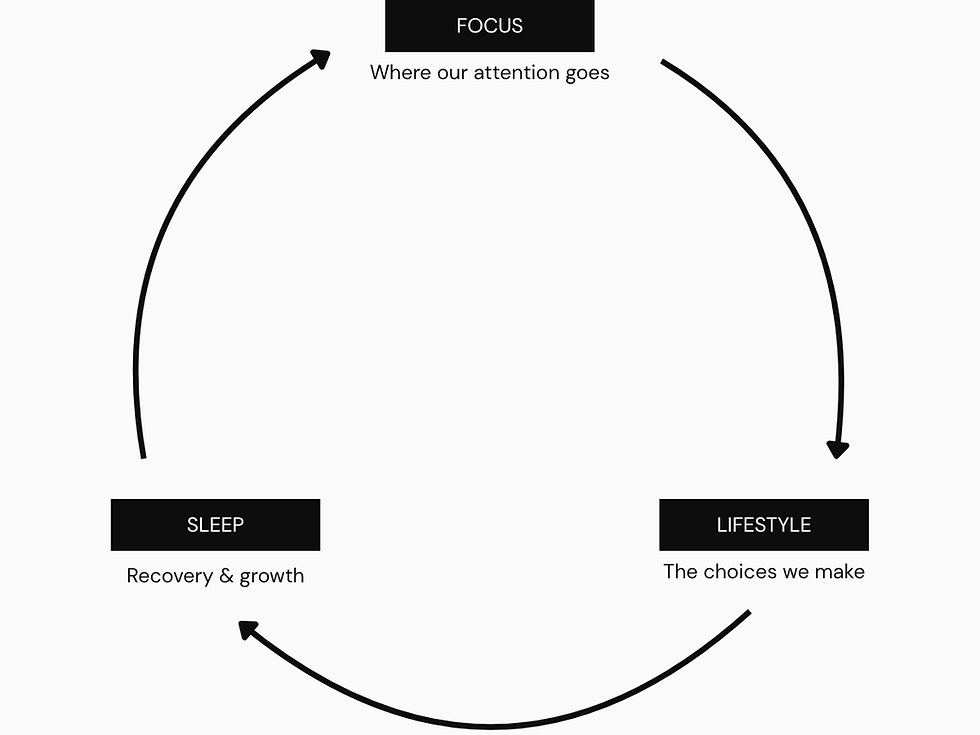
Our lives follow a consistent daily cycle of Focus, Lifestyle, and Sleep. Focus directs where our attention goes, shaping the habits and mindset we develop. Lifestyle encompasses the choices we make, how we move, eat, and interact, while Sleep restores energy and supports both physical and mental capacity. Each day is made up of 24 hours and represents our spiritual currency. How we spend this time and the choices we make reveal our true values, either building positive momentum for growth or reinforcing negative patterns.
Values
Those values are reflected in how we spend our time (spiritual currency) and money (material currency) across the domains of life. Beyond necessary recovery such as sleep, much of what we call downtime can become wasted time. While it may feel deserved, it rarely contributes to future growth and often appears in the form of procrastination or distraction. These patterns reinforce behaviours that pull us away from our potential, reflecting the concept of sin — choices that move us further from who we could become.
In the diagram, downtime sits at the centre — the more it grows, the more it consumes the space the domains need.

In the table, fill in the number of hours you spend in each domain in a standard day versus a day off. To make it easier, treat one month as four weeks, giving thirteen months in a year.
DOMAIN | Day | Day off | Week | Week off | Month | Monthoff | Year | Year off |
Physical | ||||||||
Intellectual | ||||||||
Material | ||||||||
Spiritual | ||||||||
Social | ||||||||
Environmental | ||||||||
Downtime | ||||||||
Sleep |
This can be further broken down into specific categories. Below are examples, but your life may reflect them differently, and you can add more than three if needed.
Physical | Time spent | Money Spent |
Nutrition | ||
Movement | ||
Recovery |
Intellectual | Time spent | Money Spent |
Learning | ||
Art/creative | ||
New skill |
Material | Time spent | Money Spent |
Job | ||
Investments | ||
Business/Side venture |
Spiritual | Time spent | Money Spent |
Contemplating | ||
Meditating | ||
Praying |
Social | Time spent | Money Spent |
Family | ||
Friends | ||
New relations |
Environmental | Time spent | Money Spent |
Grounding | ||
Cleansing | ||
Exploring |
Downtime/Entertainment | Time spent | Money Spent |
Shows/Movies | ||
Gaming | ||
Memes/Scrolling |
Sleep | Time spent | Money Spent |
Morning routine | ||
Night routine | ||
Sleep time |
Below input the top 10 places where you actually spend your time and money — not where you think you should, but where you actually do.
Time Spent | Money Spent |
Virtues
Using the seven deadly sins as a scale to reflect on your own virtues is an informal but practical way to assess your character. This process helps identify areas for growth and highlights where you can improve, ultimately strengthening your moral foundation. Developing virtue in this way is crucial for a moral society. Striving for this ideal is a key step in both personal development and contributing positively to the world around you.
Humility — The quality of having a modest or low view of one's importance
Kindness — The quality of being friendly, generous, and considerate
Patience — The capacity to accept or tolerate delay, problems, or suffering without becoming annoyed or anxious
Appreciation — Recognition and enjoyment of the virtuous qualities of someone or something
Discipline — Being able to follow your word (the punishment is your own suffering)
Responsibility — Ownership of your behaviours
Diligence — Careful and persistent effort
Pride | 1 | 3 | 5 | 7 | 10 | Humility |
Greed | 1 | 3 | 5 | 7 | 10 | Kindness |
Wrath | 1 | 3 | 5 | 7 | 10 | Patience |
Envy | 1 | 3 | 5 | 7 | 10 | Appreciation |
Lust | 1 | 3 | 5 | 7 | 10 | Discipline |
Gluttony | 1 | 3 | 5 | 7 | 10 | Responsibility |
Sloth | 1 | 3 | 5 | 7 | 10 | Diligence |
The final assessment looks inward at the beliefs and patterns that most directly undermine development, what might be called your inner demons. These are not character flaws but unresolved experiences that quietly shape how you see yourself and the world.
Answer Rarely (1) About Average (3) Frequently (5)
Scores 20–45—Mild “Demons” 46–75—Moderate “Demons” 76–100—Extreme “Demons”
I often doubt my abilities and skills.
I have a hard time accepting compliments and praise.
I frequently compare myself to others and feel inadequate.
I am hesitant to ask for help because I do not want to appear weak.
I worry that I am not meeting the expectations of others.
I feel guilty when I prioritise my own needs and desires.
I tend to blame myself for things that are out of my control.
I tend to focus too much on my flaws and shortcomings rather than my strengths and accomplishments.
I am afraid of failure and avoid taking on new challenges or making decisions.
I feel like I need to be perfect in order to be accepted.
I am hesitant to speak up or share my opinions because I fear judgment.
I often feel like I am not good enough.
I have a hard time forgiving myself for past mistakes.
When I say 'No', I feel guilty afterwards.
I worry that others are judging me when I am around them.
I often replay past conversations or situations to see what I could have done differently.
I wake up at night worrying about mistakes I made during the day.
I am dissatisfied with my appearance and do not like the way my clothes look on me.
I feel like I must justify everything I do or say.
I feel like I do not deserve good things that happen to me.
TOTAL POINTS: _______________
Your score reflects where the work begins, not a judgment of who you are but an honest indicator of what has yet to be resolved. This is what the Personality section has been building toward: an honest picture of where you currently are. That picture is the foundation everything else rests on. A high score is not a flaw or a verdict. Most people carry some of these, and they can shift. If they feel heavy or persistent, that is exactly what working with a trusted guide or professional is for. Naming them is the start, not the end.
Power (Past) — Self-Reflection (Level 2)
Power, in this context, refers specifically to psychological development — the inner work of freeing yourself from the past so you can engage fully with the present and future. Power is not some abstract resource. It is the confidence and freedom that come from no longer being at the mercy of negative emotion or the fear of the unknown — the very source of what often holds us back. When we carry negative perspectives on past events, our power drains, giving rise to self-doubt, limiting beliefs, and overwhelming emotions that keep us confined within our comfort zones. At its core, power is about reframing — changing the meaning we assign to past experiences so they no longer define or limit us.
There are three primary ways to regain power — beyond building competence. The first and most powerful is social confrontation (confession) — going directly to the source of the discomfort and having an honest conversation regardless of the outcome. The second is reflection — viewing past experiences from multiple perspectives to extract the lessons they carry, changing the meaning we hold them with. The third is exposure — confronting the trigger directly or through repeated encounters with ideas.
One caveat: if the person at the source of your discomfort was abusive, or the relationship is unsafe, direct confrontation is not a requirement of this work. The reframing can happen through reflection, or with a professional guiding the process. Freedom does not depend on standing in front of someone who harmed you.
Confession
Although it is often the past that holds people back most — limiting the drive and power needed to achieve what once seemed impossible — overcoming it requires more than just extracting lessons. A significant component relates to confronting our current ideals, the people whose love or approval we fear losing, who often appear as internal voices shaping our behaviour from the inside. In many traditions this challenge is symbolised as facing the dragon, confronting our inner demons, or overcoming the inner critic. Through honest reflection you may begin to identify whose voice is actually behind the noise. That recognition is often what makes confession possible, because now you know who to go to.
What makes confession so impactful is the clarity of knowing where they actually stand. Most of the time the fear is not of them but of our interpretation of what they might think. A distorted version of their response that those inner voices have been running on, often bearing little resemblance to their actual response. Regardless, you build up the courage to confront it, and it is with that clarity that you are finally set free from fearing the unknown, because now you have an official answer.
When confessing, start with the biggest one: the thing you have been most afraid to say to them. This is really a test of whether they will still love you after knowing, and their response will give you that answer. You do not need to go into extreme detail; enough for them to understand the scope is usually sufficient. Sometimes starting with telling those you are less afraid to confront can help you build the courage to confront the larger dragon — the unconquered challenge guarding your greatest treasure — in this case, freedom, confidence, and peace.
This process of development reflects a continual cycle of psychological death and rebirth, where outdated patterns and identities lose their influence. As these shifts occur, our brain chemistry, perspective, actions, and ultimately our life begin to change. What once defined us no longer has to.
Reflection
Most of the internal problems we face are due to the lack of guidance or nurture we received through our upbringing. The past events themselves do not take our power. It is the meaning we assign to them. Events are neutral until we impose our subjective interpretations. Negative experiences linger when we fail to learn from them, allowing them to haunt and trigger us. By extracting lessons — no matter how painful — we free ourselves from their hold. This shift in perspective transforms our behaviour and reclaims the power we once lost. If we control the past, we can control the future.
The answers almost always exist within us. It is simply a matter of accepting the truth or intentionally searching for it.
Overcoming Past Experiences (Perspectival knowing):
This self-coaching technique involves reflecting on past negative experiences by writing about them, using perspectival knowing to gain insight into your emotions, thoughts, and actions to improve future outcomes. Be honest with yourself and consider the event from different perspectives.
1st person perspective: This perspective focuses on your subjective viewpoint, centred around your thoughts, feelings, and experiences.
Reflect on your emotions and how you felt during the event.
Consider what made the experience negative, whether it was internal or external factors.
Consider what you did, what emotions were present, how you engaged, and your role in the event.
Think about whether you would change how the experience went and why.
Reflect on how the experience affected the rest of your day, week, month, etc.
Consider whether similar experiences happen often, and what caused this experience to occur.
Reflect on your response to experiences that were out of your control and consider how you could have responded differently.
For experiences that you had control over, identify the skills or actions that could have led to a desired outcome.
As you move through the following perspectives, identify what you may have missed and what insights you can apply in the future.
2nd person perspective: Shift your perspective to view the situation from the standpoint of someone involved in the event. Consider their emotions, motivations, and experiences to gain a broader understanding.
3rd person perspective: Detach yourself emotionally and assess the event. This allows for a more logical viewpoint, though not entirely unbiased.
4th person perspective: Consider the event from a broader viewpoint, such as how a group or society might perceive or be affected by the situation.
Divine perspective: This perspective rises above individual, collective, and temporal limits. It holds all the previous perspectives at once and reveals where the experience sits within the grander scheme of existence.
Return to the first-person perspective and notice if strong emotions are still present.
If so, continue to identify what you are unwilling to learn.
If not, take the lessons learned and integrate them into your future experiences.
Exposure
Before exposure can work effectively, a foundation of competence and understanding is required. Without it, confronting triggers overwhelms rather than develops. The key skills and knowledge across the six domains, referenced in the Hero's Journey post, form this foundation. Some you will master, others you will develop just enough to be useful. The best way to build them is outlined below.
From that foundation, exposure works on two levels. The first is direct — repeatedly confronting the trigger and staying present with the response it provokes. Each encounter signals to the nervous system that the situation is survivable, and the more time spent in it, the clearer it becomes, gradually shifting perspective until what once felt overwhelming is seen more accurately. The emotion does not disappear, but its hold over behaviour and decision-making weakens with each encounter.
The second is through ideas. Encountering a concept once rarely produces genuine understanding. But reading the same idea across different sources, disciplines, and contexts allows it to eventually click. Learning how the amygdala works, for example, will not stop it from firing, but understanding why it fires and what it is doing changes your relationship to the response. You are no longer at the mercy of something mysterious. This is not passive accumulation — it is repeated exposure to the unknown until it becomes known, and the emotion it once carried dissolves.
This is why the education provided throughout this series is not just intellectual. Understanding the nervous system, personality, the domains, and the developmental levels reduces the intensity of negative emotional responses by replacing confusion with clarity. What we can name and explain loses much of its power over us.
Tips for improved propositional (scientific information) knowing:
The tips below apply to any learning — whether for healing, personal development, or building the knowledge that serves your work, career, or life.
Pre-Learning
Have a passion for what you are wanting to learn.
Understand the purpose of what you are learning (for what reason?).
Prioritise your learning if you have multiple things you want to learn.
Have objective questions or ideas of what you are looking for and are trying to learn (do not just have questions that suit your bias).
Get into a peripheral learning state (unconscious/parasympathetic state).
Learn in the environment you will be applying the information in.
During learning through reading
Utilise your peripheral vision and saccades.
Pre-read texts, look for key components and search for the questions you want answered. (If it is a video or audio, speed it up or see if it has markers of discussion points, or if they have it transcribed).
Utilise your imagination to anchor key points and ideas either with previous ideas or use new symbols and images to improve comprehension.
Pause and review the learning, with longer pauses after bigger chunks.
Post learning
Write a summary of what you learnt without going back through it.
Teach different people what you have learnt and apply it in different ways using different representational systems to retain most of the information in your long-term memory.
The key to optimising learning
Underpinning all of this is one foundational principle: optimising your health mitigates stress, and a less stressed mind learns faster, retains more, and applies knowledge more effectively.
Tips for improved procedural (skills) knowing:
When developing any skill, the process typically follows four stages: unconscious incompetence, not yet knowing what you do not know; conscious incompetence, becoming aware of the gap; conscious competence, being able to perform the skill with deliberate effort; and unconscious competence, the skill becoming second nature. Expect to move through all four.
Find a skill you want to learn
Find someone who performs this skill better than anyone else
Model what they do or use formal learning on this topic (create outcome)
Reflect on where you are and if that skill is something you want, or someone else wants for you (very important when it comes to motivation)
Reverse engineer and create the smallest steps you are willing to take towards achieving this outcome
Action: take the first step (if too anxious, the initial step was too big)
Reflect on what you tried; did it get you the result you wanted? If not, adjust the steps. If the execution of the process was off, the more you try the better you will get.
Keep trying until you are satisfied and happy with the process and execution of the outcome
If you are satisfied and have learnt that skill, find another skill you want and repeat the steps
Purpose (Future) — Self-Realisation (Level 3)
Purpose is our future compass, guiding growth and fulfilment beyond the self. Without self-awareness or the power to overcome the past, it is shaped by external forces and the expectations of others, leading us away from what we are actually capable of becoming.
Human beings share the same fundamental nature: the same biological hardware, the same social dependencies, the same need for meaning that extends beyond the individual self. A genuine purpose almost always involves contributing to something that outlasts you, whether raising children, mentoring others, or building something that serves the next generation. This is not a romantic ideal. It is the natural expression of a life lived at the higher levels of development explored in the previous post. A purpose that ends with the self is, by definition, a finite game — and therefore immoral and degenerate. No matter how refined or sophisticated it appears, it will eventually produce the same emptiness it was designed to escape.
This does not mean that everyone lives the same life or pursues it in the same way. The impact we have, based on the skills and knowledge we accumulate throughout life, will produce different results across different fields, all in service of the same PURPOSE.
This will not resonate with everyone. Some will find it too demanding, too confronting, or simply not what they want to hear. But the work this series has been pointing toward was never about feeling good. It was about peace. Those are not always the same thing.
Until we overcome the external forces that shaped our earliest beliefs about who we are and what we deserve, we will never be able to clearly visualise our true ideal self. That is where the following questions begin.
Who do you want to be?
What does your ideal self look like to you?
What do they value?
Are they virtuous?
What habits, skills, and routines does that person have?
Why does that person strive for those things, and for whom? (Ask “Why?” multiple times to uncover the core motivation.)
What impact do you want to have?
What does that person aim to accomplish?
Where does that person envision themselves in the future?
What will happen if this is achieved?
Conversely, what will happen if it is not?
Obstacles & Solutions
What challenges or roadblocks might stand in your way?
How can you prepare to overcome these obstacles?
The cost of inaction
What will happen if you do not become this ideal person?
By answering these questions with clarity and honesty, you create a roadmap towards your ideal. The more vivid and specific your vision, the stronger your drive to make it a reality.
Now repeat the time and money exercise for your ideal self: where would that person invest across the domains?
Ideal Time Spent | Ideal Money Spent |
Once you have laid out your ideal self — the values, habits, skills, and impact you are committing to — an oath is the natural way to seal it. A vision held privately is easy to abandon. A vision declared before the people whose love and respect matter most becomes something harder to walk away from.
A wedding is the clearest surviving example of what an oath is meant to do. You stand before the people who matter most — family, friends, community — and make a public declaration of who you intend to be. The presence of those witnesses is not ceremonial. It is functional. Guilt keeps you accountable to your own ideals. Shame keeps you accountable to theirs. And the threat of losing your place among them, of exclusion from the people who give your life its meaning, is the most powerful self-governing force available to us.
When you fall short of your oath, the most effective response is confession followed by repentance — not simply asking for forgiveness, but the genuine commitment to never repeat that action. It is not the act itself that produces the deepest guilt but the intent. The conscious choice to go against what you have declared yourself to be. Where the ideal you are aiming toward is not truly yours, or not aligned with the highest good, that guilt may be telling you something different. Not that you failed the oath, but that you swore the wrong one. Either way, the commitment to your ideal self, held honestly and declared openly, is the ultimate form of self-love. Not a feeling but the discipline to sacrifice immediate pleasure for long-term growth.
This is what makes the oath both powerful and difficult. Most people will not commit to this standard. Then again, most people do not want the peace it produces badly enough to try. That is precisely where Potential begins.
Potential (Present) — Self-Actualisation (Level 4)
"If you know yourself, know the direction you are heading, and have the power within to get there — nothing can stop you."
All three pillars must be developed before Potential can be fully realised. Climb ahead with no foundation and you will fall straight back down. Wisdom cannot be borrowed from a level you have not earned, only knowledge can, and they are not the same.
When the foundation is built, Potential becomes a practice more than a destination. The daily commitment to becoming more capable, aligned, and conscious. Once we reclaim our power from the past and define our purpose for the future, the present is where transformation actually happens. It is in the now that the ideal self is forged — through action, growth, and the consistent effort to close the gap between who we are and who we are becoming.
This is expressed through two types of habits. Macro habits are the environments you occupy in your routine — the gym, the kitchen, the library, the communities you belong to — the expression of your values, revealed by where you actually choose to spend your time. Micro habits are the behaviours you act out within those environments — the expression of your character, and how you show up when no one is watching.
"You become who you consistently work on becoming."
The only thing stopping you is yourself. If you find yourself stuck, you lack one or more of the following:
Resources — you do not yet have what you need
Support — you are trying to do it alone when you should not be
Awareness — an honest picture of where you currently are
Power — something from the past has yet to be resolved
Purpose — you are working toward someone else's vision, not your own
The journey from ego to Self demands both a clear vision of our ideal and an honest assessment of who we are now. Attachment to the ego is the greatest obstacle to growth and maturity — it is the first true hurdle, separating those who choose comfort and illusion from those who seek truth. Much like the choice between the blue pill and the red pill, we can either remain in the safety of our conditioned beliefs or awaken to the deeper reality of who we truly are.
This is the Hero's Journey — not a myth about someone else but a Fool (you) who answers the call, faces the trials, and commits to the discomfort of real growth, eventually arriving somewhere the shortcuts never reach: Self-Mastery, internal peace, and the freedom that comes from no longer being at the mercy of what you have not yet developed. Every level of awareness climbed, every domain brought into greater alignment, every disruption transformed into wisdom — this is the journey lived, not read about.
Overcoming the ego is not just a step in that journey. It is the price of entry. And the process, however long it takes, remains the same: analyse yourself, learn from your past, visualise your future, and take action.

Comments